qn010@qinuo.net
Tel:+86 13616068720

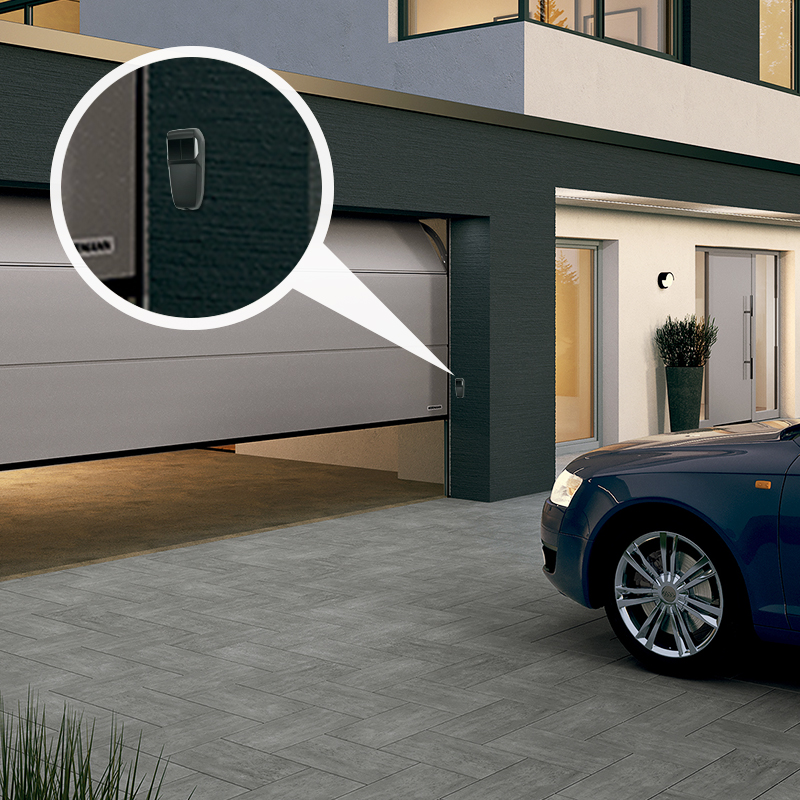
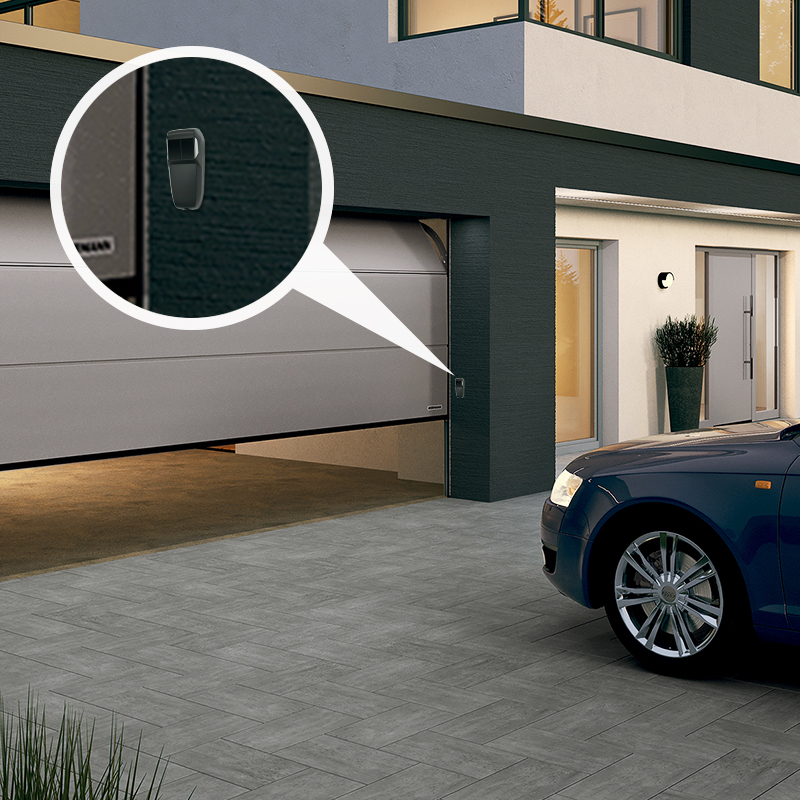
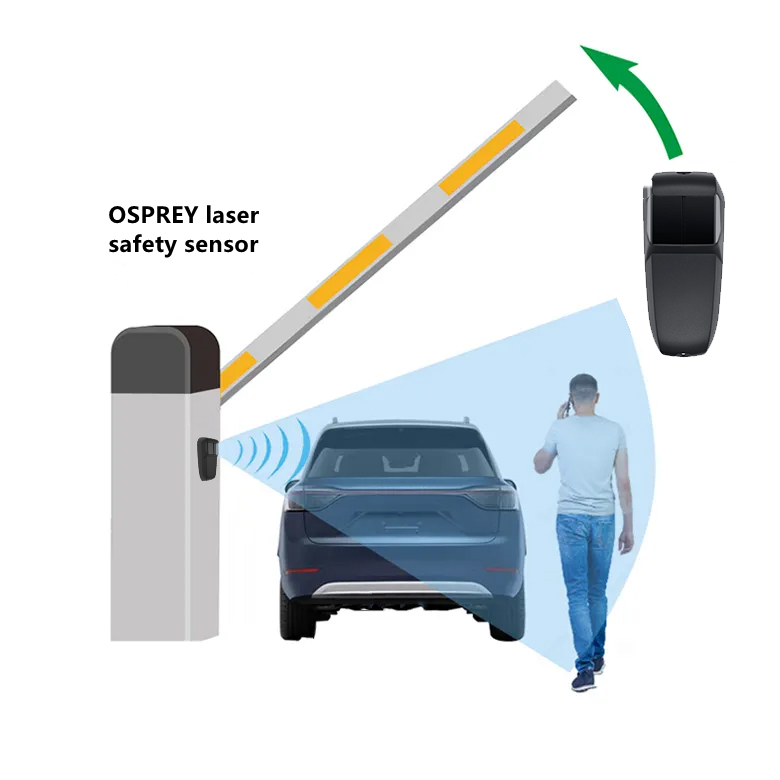
The OSPREY Laser Safety Sensor represents a modern approach to protecting both people and vehicles around automatic garage doors. Instead of relying on traditional infrared “photo-eyes” or ground-embedded induction loops, OSPREY uses laser time-of-flight (TOF) technology — a method that provides precise, real-time detection of objects in the door’s path.
Because of this, a single OSPREY unit is enough: it incorporates both transmitter and receiver in one, simplifying installation and eliminating the need for ground-level wiring or roadwork.
The sensor sends out laser pulses and measures the time it takes for reflections to return. By calculating this “time of flight,” the sensor determines the distance to any object in front of the door.
If the measured distance indicates an object (person, pet, car, bicycle, etc.) within the “learning distance,” the sensor’s red LED turns ON — triggering a signal to the door controller.
The door opener responds by stopping or reversing the door’s motion, preventing contact with the obstruction. This reaction typically occurs within a fraction of a second thanks to the sensor’s fast response time.
This mechanism is similar to how traditional “safety beams” work in garage doors. Standard setups often use infrared beams across the door opening: when that beam is broken, the door reverses. However, the laser-based system adds advantages over infrared-based or induction-loop systems.
Because laser beams are narrow and highly directional, the sensor can detect even small objects — like a pet’s paw, a child’s hand, or a small box — that might otherwise slip past an infrared beam or go undetected by a loop sensor.
The OSPREY laser sensor is less prone to interference from ambient light (sunlight, car headlights), reflections, or metal objects — issues that can disrupt ordinary infrared sensors or microwave detectors.
Since it’s a single-piece “transceiver,” there’s no need for dual mounting (transmitter + receiver) or complicated ground wiring. This reduces installation cost and complexity.
Additionally, with no mechanical parts and low power consumption (< 1.5 W standby), the device tends to require minimal maintenance.
With a response time under 100 ms, the system reacts almost instantly when an object enters the detection zone.
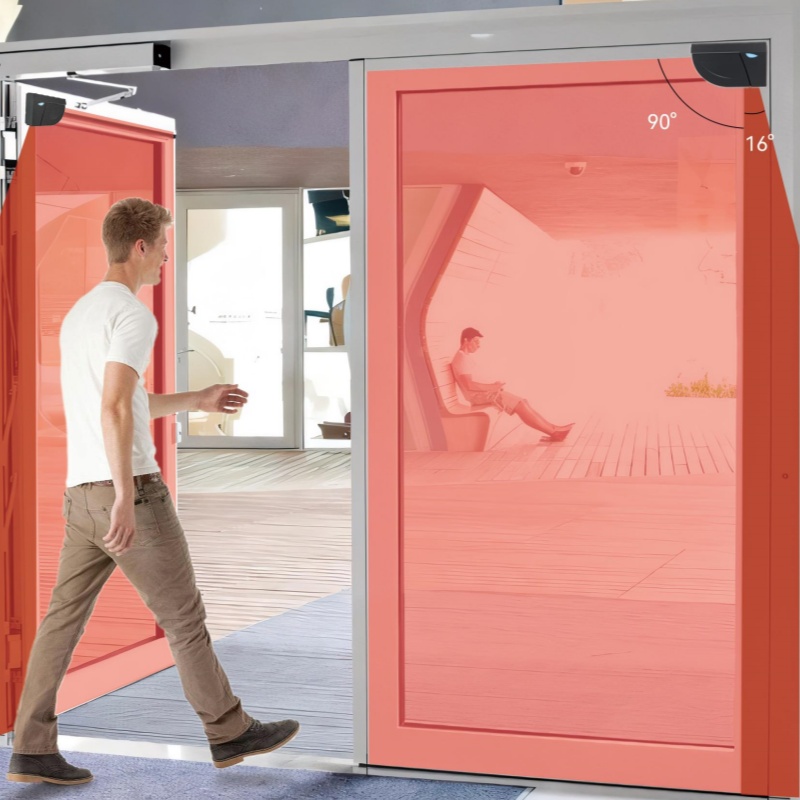
Because the sensor monitors a volume in front of the door (rather than a single line), it offers more comprehensive “collision avoidance” — from people walking in, to pets or objects near the door path. This 3D‐style detection helps reduce blind spots that simpler sensors might miss.
For garage doors — whether residential garages or commercial parking bays — OSPREY excels especially in scenarios where safety, reliability, and ease of installation matter:
Homes with children or pets: A narrow, invisible laser beam may fail to catch small or unexpected obstacles. OSPREY’s laser TOF detection reduces the risk of door closure on a child or pet.
Garages used for both vehicles and pedestrian access: The sensor can detect both slow-moving people and faster-moving cars, offering protection for everyone.
Environments with challenging ground conditions: Since no ground embedding or roadwork is needed (as opposed to induction loops), OSPREY avoids disruptions in installation and maintenance.
Outdoor or semi-outdoor garages: With adjustable detection range (0–4 m outdoor, up to 8 m indoor), the sensor remains flexible to different space layouts.
Traditional garage-door safety sensors (often infrared “photo-eyes”) typically consist of two units — a transmitter and a receiver — installed on either side of the door frame, near the floor. When the invisible beam between them is broken, the door reverses.
However, these systems have several limitations:
They may fail in bright sunlight or due to reflections, causing false triggers or missed detection.
Small or narrow objects (like a pet’s paw or a thin bicycle wheel) might pass under or between beams undetected.
Installation typically requires two mounting points + wiring on both sides of the door, increasing complexity.
By contrast, the OSPREY sensor — with its single-unit, TOF-based laser scanning — addresses many of those issues: improving accuracy, simplifying installation, reducing interference, and broadening detection coverage.
The OSPREY Laser Safety Sensor for Garage Door is not just a “nice-to-have” optional upgrade — it represents a meaningful evolution in garage-door safety. Its laser TOF technology offers fast, accurate, and reliable detection of obstacles, protecting humans, pets, and vehicles from potential harm. At the same time, it simplifies installation and minimizes maintenance compared to traditional sensors.
For anyone looking to modernize their garage door system — whether in a home, small business, or parking facility — OSPREY is a robust, future-proof solution that significantly raises the safety standards.